
- Goldberg LR, Heiss CJ: The Effect of Appearance on the Palatability of Thickened Apple Juice A Pilot Study. Top Clin Nutr 2013 28:154-162.
Article summary - Hill R, Dodrill P, Bluck LJC and Davies PSW: A Novel Stable Isotope Approach for Determining the Impact of Thickening Agents on Water Absorption. Dysphagia 2010, 25:1-5
(Sceintific Article Summary by Laura Sergi McGill Dietetic Stagiaire Level IV)

DOCUMENTS AND TOOLS
Summary of Scientific Articles (pdf format):
Lists of recent scientific publications on dysphagia (pdf format):
A note to readers: To obtain a quick reference document use the references without abstracts. This will allow you to decide whether or not you wish to print out the complete abstract. The document with abstracts is much longer.
Article “Dysphagia: Implications for older people” (a good summary article on dysphagia in the elderly published online November 2013)
Free full text publications for February 2014:
- Click on the link: Intratumoural injection of absolute alcohol in carcinoma of gastroesophageal junction for palliation of dysphagia.
- Click on the link: 4D-flow MRI of double aortic arch in a 14-year-old patient
- Click on the link: Videofluoroscopy-guided balloon dilatation for the opening dysfunction of upper esophageal sphincter by postoperative vagus nerve injury: a report on two cases.
- Click on the link: Comparison of different gum-based thickeners using a viscometer and line spread test: a preliminary study.
- Click on the link: Associating factors regarding nasogastric tube removal in patients with Dysphagia after stroke.
- Click on the link: Eagle’s syndrome: a case report.
- Click on the link: Emphysema following vitrectomy with fluid-gas exchange: description of a rare complication
- Click on the link: Ivor-Lewis esophagectomy for esophageal cancer after distal gastrectomy.
- Click on the link: Altered cortical swallowing processing in patients with functional Dysphagia: a preliminary study.
- Click on the link: A large esophageal gastrointestinal stromal tumor that was successfully resected after neoadjuvant imatinib treatment: case report.
- Click on the link: A rare recurrence of bilateral breast cancer in the esophagus coincidentally associated with primary gastric cancer: a case report.
- Click on the link: Single-stage surgical repair of airway gastric fistula after esophagectomy.
- Click on the link: Cervical oesophagostomy in patients with severe dysphagia following radiotherapy for nasopharyngeal carcinoma.
- Click on the link: Pharyngoesophageal diverticulum perforation 18 years after anterior cervical fixation.
- Click on the link: An unusual case of dysphonia and dysphagia.
- Click on the link: Effects of barium concentration on oropharyngeal swallow timing measures.
- Click on the link: Computed tomography pulmonary findings in healthy older adult aspirators versus nonaspirators.
Free full text publications for January 2014:
- Click on the link: Endoscopic diagnosis of cervical esophageal heterotopic gastric mucosa with conventional and narrow-band images.
- Click on the link: The effect of changing the sequence of cuff inflation and device fixation with the
LMA-Supreme - Click on the link: Transoral, retromolar, para-tonsillar approach to the styloid process in 6 patients with Eagle’s syndrome.
- Click on the link: Niemann-Pick type C Suspicion Index tool: analyses by age and association of manifestations.
- Click on the link: Clinical dysphagia risk predictors after prolonged orotracheal intubation.
- Click on the link: Effect of Cold Water on Esophageal Motility in Patients With Achalasia and Non-obstructive Dysphagia: A High-resolution Manometry Study.
- Click on the link: Utilizing intrabolus pressure and esophagogastric junction pressure to predict transit in patients with Dysphagia.
- Click on the link: Dermatomyositis-Erythrodermia: Clinical Presentation not Associated to Malignancy. A Case Report
Free full text publications for December 2013
- Click on the link: An unusual cause of dysphagia: thoracic aorta aneurysm
- Click on the link: You are never too old for a congenital disease
- Click on the link: Fibrous Variant of Hashimoto’s Thyroiditis as a Diagnostic Pitfall in Thyroid Pathology
- Click on the link: Evaluation of a Clinical Service Model for Dysphagia Assessment via Telerehabilitation
- Click on the link: Amyloid goiter associated with amyloidosis secondary to rheumatoid arthritis
- Click on the link: Marchiafava-Bignami disease mimics motor neuron disease: case report
- Click on the link: Electrical Stimulation in Treatment of Pharyngolaryngeal Dysfunctions
- Click on the link: Overview of systematic reviews and meta-analyses of acupuncture for stroke
- Click on the link: Are alarm symptoms predictive of cancer survival
- Click on the link: Esophageal perforation post pneumatic dilatation for achalasia managed by esophageal stenting
- Click on the link: Rehabilitation approaches to dysphagia that was developed for a patient who attempted to commit suicide by hanging: a case report
- Click on the link: Diffusion-weighted imaging and diffusion-weighted whole-body imaging with background body signal suppression for characterizing esophageal cancer: a case report.
- Click on the link: Oculopharyngeal muscular dystrophy: underdiagnosed disease in Hong Kong
- Click on the link: Achalasia – balloon dilation or surgery?
- Click on the link: Characteristics and management of congenital esophageal stenosis: findings from a multicenter study.
- Click on the link: Guideline clinical nutrition in patients with stroke.
- Click on the link: Benchmarks for acute stroke care delivery.
- Click on the link: A randomized, double-blind study of repeated incobotulinumtoxinA (Xeomin(®)) in cervical dystonia
- Click on the link: Age-related Differences in Tongue-Palate Pressures for Strength and Swallowing Tasks.
- Click on the link: Patients attended by palliative care teams: are they always comparable populations?
Free full text publications for November 2013
- Click on the link: Dumbbell-Shaped Abducens Schwannoma: Case Report
- Click on the link: Risk factors for community-acquired pneumonia in adults in Europe: a literature review.
- Click on the link: Is Dor fundoplication optimum after laparoscopic Heller myotomy for achalasia? A meta-analysis
Free full text publications for October 2013
- Click on the link: Transoral, retromolar, para-tonsillar approach to the styloid process in 6 patients with Eagle’s syndrome
- Click on the link: Dysphagia in Lewy body dementia – a clinical observational study of swallowing function by videofluoroscopic examination.
- Click on the link: Endoscopic and clinicopathological patterns of esophageal cancer in Tanzania: experiences from two tertiary health institutions.
- Click on the link: A safe anastomotic technique of using the transorally inserted anvil (OrVilTM) in Roux-en-Y reconstruction after laparoscopy-assisted total gastrectomy for proximal malignant tumors of the stomach
- Click on the link: Anterior cervical osteophytes causing Dysphagia and paradoxical vocal cord
- Click on the link: Contributing factors analysis for the changes of the gross motor function in children with spastic cerebral palsy after physical therapy
- Click on the link: Comparison of swallowing functions between brain tumor and stroke patients
- Click on the link: Factors associated with compliance with viscosity-modified diet among dysphagic patients
- Click on the link: Exploring scale-up, spread, and sustainability: an instrumental case study tracing an innovation to enhance dysphagia care
Free full text publications for September 2013
- Click on the link: Who Receives Home Based Perinatal Palliative Care
- Click on the link: Kennedy disease misdiagnosed as polymyositis
- Click on the link: Medical management of thyroid ectopia
- Click on the link: Dysphagia in Head and Neck Cancer Patients: Pretreatment Evaluation
- Click on the link: Does maintaining endotracheal tube cuff pressure at 20 mm Hg
- Click on the link: Measuring patient-reported outcomes in advanced gastric cancer
- Click on the link: Pyridostigmine-induced high grade SA-block
- Click on the link: Pseudoachalasia: A peculiar case report
- Click on the link: Extremely rare case of primary esophageal mucous
- Click on the link: Multi-detector row computed tomographic evaluation of a rare type
- Click on the link: Central pontine myelinolysis in a chronic alcoholic patient
- Click on the link: Dual-sided composite mesh repair of hiatal hernia
- Click on the link: Helical tomotherapy: an innovative radiotherapy technique for the treatment
- Click on the link: Clinical complete responders to definite chemoradiation or radiation therapy
- Click on the link: A rare cause of dysphagia: compression of the esophagus by an anterior cervical
- Click on the link: Effect of 45° reclining sitting posture on swallowing in patients with dysphagia
- Click on the link: Swallowing and deep brain stimulation in Parkinson’s disease
- Click on the link: Long-term efficacy and safety of incobotulinumtoxinA injections
- Click on the link: Embedded cervical esophagogastrostomy: a simple and convenient method
- Click on the link: Dysphagia Lusoria Caused by Kommerell Diverticulum
Free full text publications for August 2013
- Click on the link: Gastric and duodenal squamous cell carcinoma
- Click on the link: Endoscopic approach to achalasia
- Click on the link: Hospital acquired pneumonia is linked to right hemispheric
- Click on the link: Development of a System to Monitor Laryngeal Movement
- Click on the link: Epidemiological assessment and therapeutic response in hypopharyngeal
- Click on the link: Oropharyngeal dysphagia in patients with multiple sclerosis
- Click on the link: Influence of endoscopic submucosal dissection on esophageal
- Click on the link: Validity and Reliability of the Korean Version of the MD
- Click on the link: Multi-Detector Row Computed Tomographic
- Click on the link: Zenker’s diverticulum: exploring treatment options
- Click on the link: Lymphoid papillary hyperplasia of the palatine tonsil
- Click on the link: A rare cause of dysphagia: compression of the esophagus
- Click on the link: The Frequencies of Gastroesophageal and Extragastroesophageal
Free full text publications for July 2013
- Click on the link: A giant primary thyroid fibrosarcoma in
- Click on the link: Superior socio-medical alternative to feeding gastrostomy and jejunostomy
- Click on the link: Correlation between inflammatory factors and post-stroke
- Click on the link: Long-term facial nerve function following facial reanimation
- Click on the link: Risk of excessive sodium intake in the use of a thickener
- Click on the link: Lichen planus is an uncommon cause of nonspecific
- Click on the link: An 81-year-old gentleman with symptomatic Bochdalek hernia
- Click on the link: Complications due to the use of BMP/INFUSE in spine surgery
- Click on the link: Lung transplantation triggered “jackhammer esophagus”
- Click on the link: A case of eosinophilic esophagitis discovered
- Click on the link: Weight loss, dysphagia and supplement intake in patients with amyotrophic lateral sclerosis
- Click on the link: Image-Guided Radiotherapy for Locally Advanced Head and Neck Cancer
- Click on the link: Esophageal histoplasmosis in a renal allograft recipient.
- Click on the link: Does hyperbaric oxygen therapy have the potential to improve salivary
- Click on the link: Effect of lingual plates on generating intra-oral pressure
- Click on the link: Parkinson Disease Affects Peripheral Sensory Nerves in the Pharynx
- Click on the link: Tracheo-oesophageal compression due to massive spontaneous
Free full text publications for June 2013
- Click on the link: Fiberoptic endoscopy evaluation of swallowing
- Click on the link: Early experiences of minimally invasive surgery to treat
- Click on the link: Cough reflex testing in Dysphagia following stroke
- Click on the link: Arterio-oesophageal fistula caused by aberrant right
- Click on the link: Matching the rheological properties of videofluoroscopic contrast
- Click on the link: Radiological image-guided placement of covered niti-s stent
- Click on the link: Allograft dermal matrix hiatoplasty during laparoscopic primary
Free full text publications for May 2013
- Click on the link: Early experiences of minimally invasive surgery
- Click on the link: Esophageal reconstruction with remnant stomach
- Click on the link: Esophageal sphincter device for gastroesophageal
- Click on the link: Long-term efficacy and safety of incobotulinumtoxinA
- Click on the link: Vocal cord paralysis secondary to spontaneous internal carotid
- Click on the link: Improvement of dysphagia in a child affected by Pompe
- Click on the link: Dysphagia as a predictor of outcome and transition to palliative
- Click on the link: Thickening agents used for dysphagia management
- Click on the link: A phase II single-arm study of induction chemotherapy
- Click on the link: The feasibility and test-retest reliability of the Dutch
Free full text publications for April 2013
- Click on the link: The coexistence of myasthenia gravis and myotonic
- Click on the link: Feasibility of a novel two-piece nasogastric feeding
- Click on the link: Single-stage surgical repair in a complex case of aberrant right
- Click on the link: Paraneoplastic necrotizing myopathy associated with adenocarcinoma
- Click on the link: Dysphagia lusoria: A late onset presentation
- Click on the link: Bone morphogenetic protein in complex cervical spine surgery
- Click on the link: Efficacy and Safety of IncobotulinumtoxinA in Subjects Previously
- Click on the link: Esophageal lichen planus: A case report
- Click on the link: Minimal access surgery compared with medical management
- Click on the link: Long-term morbidities in stroke survivors: a prospective
- Click on the link: Radiation therapy and esophageal cancer
- Click on the link: Clinical features and a mutation with late onset of limb
- Click on the link: Electrical stimulation therapy of the lower esophageal sphincter
Free full text publications for March 2013
- Click on the link: Missing screw as a rare complication
- Click on the link: Late onset atypical pantothenate kinase associated
- Click on the link: Adenocarcinoma in colonic interposition
- Click on the link: Peroral endoscopic myotomy for treatment of achalasia
- Click on the link: Tuberculous osteomyelitis of the hyoid bone
- Click on the link: Epstein Barr virus associated lymphoepithelial carcinoma
- Click on the link: Case report and review of esophageal lichen planus
- Click on the link: Esophageal sarcoidosis a review of cases
- Click on the link: Aortoesophageal Fistula after Endovascular Repair
- Click on the link: Tracheo oesophageal compression due to massive spontaneous
- Click on the link: Early stage squamous cell carcinoma of the oropharynx
- Click on the link: Endoscopic approaches to treatment of achalasia
- Click on the link: Parapharyngeal liposarcoma a case report
- Click on the link: Performance measures for in hospital care of acute ischemic stroke
- Click on the link: Differences in the peak cough flow among stroke patients
- Click on the link: Arterio oesophageal fistula caused by aberrant right subclavian
- Click on the link: Hypometabolism in the supplementary and anterior cingulate
- Click on the link: The role of one year endoscopic follow-up for the esophageal remnant
- Click on the link: Nutrition impact symptoms in advanced cancer patients
- Click on the link: A novel method for the treatment of dysphagia lusoria
- Click on the link: Noninvasive detection of thin liquid aspiration using dual axis
Free full text publications for February 2013
- Click on the link: Extranasopharyngeal angiofibroma
- Click on the link: Mirtazapine treatment of diabetic gastroparesis as a novel
- Click on the link: Free Jejunal Graft Repair after PharyngoLaryngo Esophagectomy
- Click on the link: Food impaction in older age
- Click on the link: Current hurdles in the management of eosinophilic oesophagitis
- Click on the link: Type I Arnold-Chiari malformation with bronchiectasis
- Click on the link: Hybrid Procedure for a Kommerell’s Diverticulum
- Click on the link: Respiratory flutter syndrome in a neonate
- Click on the link: An evidence based review of botulinum toxin
- Click on the link: Clinical validation of the nursing diagnosis Risk for Aspiration
- Click on the link: Quality of life of esophagectomized patients
Free full text publications for January 2013
- Click on the link: Comparison of clinical performance of the I gel with LMA proseal
- Click on the link: Enlarging neck masses in the elderly Histological and surgical considerations
- Click on the link: Laparoscopic Heller’s cardiomyotomy
- Click on the link: Single incision laparoscopic approach for esophageal achalasia A case report
- Click on the link: Clinical value of preventive balloon dilatation
- Click on the link: Tetanus pathophysiology treatment and the possibility
- Click on the link: Nutrition impact symptoms in advanced cancer patients
- Click on the link: Disease and patient characteristics in NP C patients
- Click on the link: Autosomal dominant cerebellar ataxia type III
- Click on the link: Intensity modulated radiotherapy IMRT combined with concurrent
- Click on the link: How to perform and interpret upper esophageal sphincter
- Click on the link: Balloon dilation in sporadic inclusion body myositis
- Click on the link: Improvement of endocytoscopic findings after per oral endoscopic
- Click on the link: Esophageal Achalasia An Uncommon Complication during Pregnancy
- Click on the link: Development and validation of a registry based
- Click on the link: Small cell neuroendocrine carcinoma of the esophagus
- Click on the link: Aortoesophageal fistula after thoracic endovascular aortic
- Click on the link: Swallowing disorders in nursing home residents
- Click on the link: Hypometabolism in the supplementary and anterior cingulate
- Click on the link: Foscarnet resistant cytomegalovirus esophagitis
- Click on the link: Optimal approaches for measuring tongue
- Click on the link: Mucoepidermoid carcinoma of the tongue base
- Click on the link: Gastric adenocarcinoma after gastric bypass
- Click on the link: Implementation of stroke Dysphagia screening
- Click on the link: Esophageal sarcoidosis a review
- Click on the link: Clinical features of inflammatory myopathies
- Click on the link: Airway Somatosensory Deficits and Dysphagia
How does journal club work?
Journal club is a dynamic tool that provides access to necessary resources so that you can obtain recent or older publications on dysphagia and related topics quickly.
From month to month you will find a summary of information (Complete summary: Article critique; Partial summary: Pubmed publications for the month). These will allow you to quickly view the content of articles and will help to provide you with available literature.
If a colleague makes reference to research results that you are unsure about, you can verify the validity of the article and make your own opinion on the topic in question. Knowledge of research literature will also allow you to support and justify the clinical decisions you make.
If you find a relevant article which has not been cited here, we invite you to share it with us.
Articles are listed in 5 sub-sections:
- Feeding and dysphagia
- Dysphagia: etiology and other pertinent references
- Nutrition, malnutrition, body mass index and their association with health status
- Aspiration and pneumonia
- Rheology and food science
Happy reading!
Journal Club References
Feeding and Dysphagia
- Tsukada T, Taniguchi H, Ootaki S, Yamada Y, Inoue M: Effects of food texture and head posture on oropharyngeal swallowing. J Appl Physiol. 2009 Jun;106(6):1848-57
Article en pdf: Article FoodTexture & HeadPosture - Germain I, Dufresne T and Gray-Donald K: A Novel Dysphagia Diet Improves the Nutrient Intake of Institutionalized Elders. JADA 2006 (in press) (Fichelecture_GermainGrayDonaldDufresne.pdf)
- Steele CM: Searching for Meaningful Differences in Viscosity. Dysphagia 2005 Fall; 20(4): 336-8.
- Paik NJ, Han TR, Park JW: Categorization of Dysphagia Diets with the Line Spread Test Arch Phys Med Rehabil 2004; 85: 857-861.
- Macqueen CE, Tauber S, Cotter D et al.: Which commercial thickening agent do patients prefer? Dysphagia 2003;18:46-52
- Steele CM: The Rheology of Liquids: A Comparison of Clinicans’ Subjective Impressions and Objective Measurement. Dysphagia 2003 Fall; 18: 182-195.
- Stahlman LB, Garcia JM, Chamber E: Perceptual ratings of pureed and molded peaches for indiciduals with and without impaired swallowing. Dysphagia 2001;16:254-262.
- Whelan K: Inadequate Fluid Intakes in Dysphagic Acute Stroke Clin Nut 2001; 20(5):423-428.
- Philip KEA, Greenwood CE: Nutrient Contribution of Infant Cereals Used as Fluid Thickening Agents in Diets Fed to the Elderly. JADA 2000;100:549-554.
- Etlmstahl S, Bulow M, Ekberg O et al.: Treatment of Dysphagia Improves Nutritonal Conditions in Stroke Patients Dysphagia 1999;14:61-66.
- Tymchuck D: Textural Property Considerations of Food for Dysphagia. Nutrition in Clinical Practice 1999;14:S57-S59.
- Glassburn DL, Deem JF: Thickener Viscosity in Dysphagia Management: Variability among Speech-Language Pathologists. Dysphagia 1998;13:218-22.
- Pelletier CA: A comparison of consistency and taste of five commercial thickeners. Dysphagia 1997;12:74-78.
- Cassens D, Johnson E, Keelan S: Enhancing Taste, Texture, Appearance, and Presentation of Pureed Food Improved Resident Quality of Life and Weight Status. Nutrition Reviews 1996;54:S51-S54.
- Mann LL, Wong K: Development of an objective method for assessing viscosity of formulated foods and beverages for the dysphagic diet. JADA 1996;96:585-588.
- Groher ME, McKaig TN: Dysphagia and dietary levels in skilled nursing facilities. JAGS 1995;43:528-532.
- Johnson RM, Smiciklas-Wright H, Soucy IM, Rizzo JA: Nutrient Intake of Nursing-Home Residents Receiving Pureed Foods or a Regular Diet. JAGS 1995;43:344-348.
- Groher ME: Determination of the risks and benefits of oral feeding. [Review] [22 refs]. Dysphagia 1994;9:233-235.
- Brousseau S, Rochefort J: A l’Hôpital Sainte-Anne-de-Bellevue, La dysphagie se traite avec succès sur une grande échelle. Artère 1994;12:14-15.
- Pardoe EM: Development of a multistage diet for dysphagia. JADA 1993;93:568-571.
- Robertson HM, Pattillo MS: A Strategy for Providing Food to Patient with Neurologically Based Dysphagia. Journal of the Canadian Dietetic Association 1993;54:198-201.
- Hotaling DL: Nutritional considerations for the pureed diet texture in dysphagic elderly. Dysphagia 1992;7:81-85.
- Stanek K, Hensley C, Van Riper C: Factors affecting use of food and commercial agents to thicken liquids for individuals with swallowing disorders. Journal of the American Dietetic Association 1992;92:488-490.
- Martin AW: Dietary management of swallowing disorders. [Review] [26 refs]. Dysphagia 1991;6:129-134.
- Curran J, Groher ME: Development and dissemination of an aspiration risk reduction diet. Dysphagia 1990;5:6-12.
- Layne K, A. Feeding Strategies for the Dysphagic Patient: A Nursing Perspective. Dysphagia 1990;84-88.
- O’Gara JA: Dietary Adjustments and Nutritional Therapy During Treatment for Oral-Pharyngeal Dysphagia. Dysphagia 1990;209-212.
- Hargrove R: Feeding the severely dysphagic patient. Journal of Neurosurgical Nursing 1980;12:102-107.
Dysphagia
- Bath PMW, Bath-Hextall FJ, Smithard DG: Interventions for dysphagia in acute stroke. The Cochrane Database of Systematic Reviews, 2006, Issue 2.
- Dean KHO, Whurr R, Clarke CE et al.: Non-pharmacological therapies for dysphagia in Parkinson’s disease (Review). The Cochrane Database of Systematic Reviews, 2005, Issue 2.
- Hill M, Hughes T, Milford C: Treatment for swallowing difficulties (dysphagia) in chronic muscle disease. The Cochrane Database of Systematic Reviews, 2004, Issue 2.
- Langmore SE: Evaluation of oropharyngeal dysphagia: which diagnostic tool is superior? C urr Opin Otolaryngol Head Neck Sur g 2003; 11: 485-489.
- Perlman A, L. Dysphagia: Populations at Risk and Methods of Diagnosis. Nutrition in Clinical Practice 1999;14:S2-S9.
- Johnson ER, McKenzie SW, Rosenquist CJ, Lieberman JS, Sievers AE: Dysphagia following stroke: quantitative evaluation of pharyngeal transit times. Archives of Physical Medicine & Rehabilitation 1992;73:419-423.
- Castell DO and Donner MW: Evaluation of Dysphagia: A Careful History is Crucial Dysphagia 1987;2:65-71
- Groher ME, Bukatman MS: The Prevalence of Swallowing Disorders in Two Teaching Hospitals. Dysphagia 1986;1:3-6.
Nutrition, malnutrition, body mass index and their association with health status
- Milne AC, Potter J, Avenell A: Protein and energy supplementation in elderly people at risk from malnutrition. The Cochrane Database of Systematic Reviews, 2006, Issue 2.
- Casarett D, Kapo J, Caplan A: Appropriate Use of Artificial Nutrition and Hydration – Fundamental Principles and Recommendations NEJM 2005; 353;24:2607-2612.
- Rudman AN and Simmons SF: Individualizing Nutritional Care with Between-Meal Sancks for Nursing Home Residents JAMDA 2005; May/June 215-218.
- Wendland BE, Greenwood CE, Weinberg I et al.:Malnutrition in Institutionalized Seniors: The Iatrogenic Component. JAGS 2003; 51: 85-90
- Dennis M, Lewis S, Cranswick G, Forbes J. FOOD: a multicentre randomised trial evaluating feeding policies in patients admitted to hospital with a recent stroke. Health Technol Assess 2006; 10(2) – (FOOD Trial Collaboration)
Poor Nutritional Status on Admission Predicts Poor Outcomes After Stroke – Observational Data From the FOOD Trial (FOOD Trial Collaboration). Stroke 2003; 34: 1450-1456. - Bernstein MA, Tucker KL, Ryan ND et al.: Higher dietary variety is associated with better nutritional status in frail elderly people JADA 2002; 8: 1096-1104.
- Hall K, Whiting S and Comfort B: Low Nutrient Intake Contributes to Adverse Clinical Outcomes in Hospitalized Elderly Patients Nut Reviews 2000; 58(7): 214-217.
- Hudson HM, Daubert CR, Mills RH: The Interdependency of Protein-Energy Malnutrition, Aging and Dysphagia. Dysphagia 2000;15:31-38.
- Allison DB, Gallagher D, Heo M, Pi-Sunyer FX, Heymsfield SB: Body Mass Index and All-Cause Mortality Among People Age 70 and Over: The Longitudinal Study of Aging. International Journal of Obesity 1997;21:424-431.
- Thomas DR, Goode PS, Tarquine PH, Allman RM: Hospital-Acquired Pressure Ulcers and Risk of Death. JAGS 1996;44:1435-1440.
- Frisoni GB, Franzoni S, Rozzini R, Ferrucci L, Boffelli S, Trabucchi M: Food Intake and Mortality in the Frail Elderly. Journal of Gerontology 1995;50-A:M203-M210.
- Keller HH: Weight Gain Impacts Morbidity and Mortality in Institutionalized Older Persons JAGS 1995;43:165-169.
- Abbasi AA and Rudman D: Undernutrition in the Nursing Home: Prevalence, Consequences, Causes and Prevention, Nut Reviews 1994; 4:113-122.
- Ho SC, Woo J, Sham A: Risk Factor Change in Older Persons, a Perspective From Hong Kong: Weight Change and Mortality. Journal of Gerontology 1994;49:M269-M272.
- Sullivan DH, Walls RC: Impact of Nutritional Status on Morbidity in a Population of Geriatric Rehabilitation Patients. JAGS 1994;42:471-477.
- Breslow RA, Hallfrisch J, Guy DG, Crawley B, Goldberg AP: The Importance of Dietary Protein in Healing Pressure Ulcers. JAGS 1993;41:357-362.
- Keller HH: Malnutrition in Institutionalized Elderly: How and Why? JAGS 1993;41:1213-1218.
- Kerstetter JE, Holthausen BA, Fitz PA: Nutrition and nutritional requirements for the older adult. [Review] [64 refs]. Dysphagia 1993;8:51-58.
- Lipski PS, Torrance A, Kelly PJ et al. A Study of Nutritional Deficits of Long-Stay Geriatric Patients. Age and Ageing 1993; 22: 244-255.
- Nelson KJ, Coulston AM, Sucher KP, Tseng RY: Prevalence of Malnutrition in the Elderly Admitted to Long-Term-Care Facilities. JADA 1993;93:459-461.
- Bergstrom N, Braden B: A Prospective Study of Pressure Sore Risk among Institutionalized Elderly. JAGS 1992;40:747-758.
- Cornoni-Huntley JC, Harris TB, Everett DF, et al: An Overview of Body Weight of Older Persons, Including the Impact on Mortality. Journal of Clinical Epidemiology 1991;44:743-753.
- Mowé M and Bohmer T: The Prevalence of Undiagnosed Protein-Calorie Undernutrition in a Population of Hospitalized Elderly Patients JAGS 1991; 39: 1089-1092.
- Fischer J and Johnson MA: Low body weight and weight loss in the aged. JADA 1990; (12):1697-1706.
- Sullivan DH, Patch GA, Walls RC, Lipschitz DA: Impact of Nutrition Status on Morbidity and Mortality in a Select Population of Geriatric Rehabilitation Patients. American Journal of Clinical Nutrition 1990;1990:749-758.
- Rudman D and Feller AG: Protein-Calorie Undernutrition in the Nursing Home JAGS 1989; 37: 173-183.
- Potter JF, Schafer DF, Bohi RL: In-Hospital Mortality as a Function of Body Mass Index: An Age-Dependent Variable. Journal of Gerontology 1988;43:M59-M63.
- Windsor JA, Knight GS, Hill GL: Wound Healing Response in Surgical Patients: Recent Food Intake is More Important Than Nutritional Status. British Journal of Surgery 1988;75:135-137.
- Young ME: Malnutrition and Wound Healing. Heart and Lung 1988;17:60-67.
Campbell-Taylor I, Fisher RH: The clinical case against tube feeding in palliative care of the elderly. [Review] [39 refs]. JAGS 1987;35:1100-1104. - Dwyer JT, Coleman KA, Krall E, et al: Changes in Relative Weight Among Institutionalized Elderly Adults. Journal of Gerontology 1987;42:246-251.
- Allman RM, Laprade CA, Noel LB, et al: Pressure Sores Among Hospitalized Patients. Annals of Internal Medicine 1986;1986:337-342.
- Pinchcofsky-Devin GD, Kaminski MV: Correlation of Pressure Sores an Nutritional Status. JAGS 1986;34:435-440.
- Siebens H, Trupe E, Siebens A, et al: Correlates and Consequences of Eating Dependency in Institutionalized Elderly. JAGS 1986;192-198.
- Bastow MD, Rawlings J and Allison SP: Benefits of supplementary tube feeding after fractured neck of femur: a randomise controlle trial. BMJ 1983; 287:1589-1592.
- Biena R, Ratcliff S, Barbour GL, Kummer M: Malnutrition in the Hospitalized Geriatric Patient. JAGS 1982;30:433-436.
- Lipschitz DA and Mitchell CO: The Correctability of the Nutritional, Immune, and Hematopoietic Manifestation of Protein Calorie Malnutrition in the Elderly. J Am Coll Nut 1982; 1:17-25.
- Seltzer MH, Slocum BA, Cataldi-Betcher EL: Instant Nutritional Assessment: Absolute Weight Loss and Surgical Mortality. JPEN 1982; 6: 218-221.
- Weinsier RL, Hunker EM, Krumdieck CL et al.: A prospective evaluation of general medical patients during the course of hospitalization. Am J Clin Nut 1979;32:418-426.
- Bistrian B, R., Blackburn G, L., Vitale J, Cochran D, Naylor J: Prevalence of Malnutrition in General Medical Patients. JAMA 1976;235:1567-1570.
Aspiration and pneumonia
- Roubenoff R, Mayer J: Feeding tubes in prevention of pneumonia [letter; comment]. Lancet 1997;349:433.
- Finucane TE, Bynum JP: Use of tube feeding to prevent aspiration pneumonia [Review] [28 refs]. Lancet 1996;348:1421-1424.
- Langmore SE: Managing the Complications of Aspirations in Dysphagic Adults. Seminars in Speech and Language 1991;12:171-184.
- Jacobs S, Chang R, W.S., Lee B, Bartlett F: Continuous Enteral Feeding: A Major Cause of Pneumonia among Ventilated Intensive Care Unit Patients. Journal of Parenteral and Enteral Nutrition 1990;14:353-356.
Rheology and Food Science
- Tsukada T, Taniguchi H, Ootaki S, Yamada Y, Inoue M: Effects of food texture and head posture on oropharyngeal swallowing. J Appl Physiol. 2009 Jun;106(6):1848-57
Article en pdf: Article FoodTexture & HeadPosture - Germain I, Dufresne T and Ramaswamy HS: Rheological characterization of thickened beverages used in the treatment of dysphagia. J Food Eng , Available on Internet, 2005.
- Smith TL, Sun MM and Pippin J: Characterizing Process Control of Fluid Viscosities in Nursing Homes JADA 2004; 104:969-971.
- Hoffman SM, Nicosia MA, Robbins J: Line Spread Test – Is it Able to Measure Viscosity. Dysphagia 1999;14 (Abstract)
- Mills RH: Rheology Overview: Control of Liquid Viscosities in Dysphagia Management. Nutrition in Clinical Practice 1999;14:S52-S59.
- Tsaf SJ, Unklesbay N, Unklesbay K, Clarke A: Textural Properties of Restructured Beef Products with Five Binders at four Isothermal Temperatures. Journal of Food Quality 1998;21:397-410.
- Mann LL, Wong K: Development of an objective method for assessing viscosity of formulated foods and beverages for the dysphagic diet. JADA 1996;96:585-588.
- Ramaswamy HS, Basak S, Van de Voort FR: Effect of Strawberry Concentrate on Apple Sauce Rheology. Canadian Agricultural Engineering 1994;36:109-115.
- Saravacos GD: Effect of Temperature on Viscosity of Fruit Juices and Purees. Journal of Food Science 1970;35:122-125.
Brandt MA: Texture Profile Method. Journal of Food Science 1963;28:404-409. - Szczesniak AS, Brandt MA, Friedman HH: Development of Standard Rating Scales for Mechanical Parameters of Texture and Correlation Between the Objective and the Sensory Methods of Texture Evaluation. Journal of Food Science 1963;397-403.
- Szczesniak AS: Classification of Textural Characteristics. Journal of Food Science 1963;385-389.
- Szczesniak AS: Objective Measurements of Food Texture. Journal of Food Science 1963;28:410-420.
Many references are pertinent to our practice
Several authors publish a significant amount of literature on the topic of dysphagia. Some of this information may be less clinical or practice based however we have access to this valuable literature and it is important to be aware of it.
By keeping these references on hand, when you and your colleagues discuss recent references you will be able to formulate your own opinion of the available published literature.
We would like to share some of this literature with you, allowing you to formulate your own opinions on various subjects.
List of pertinent documents
Power Point Presentation on the article by Hill R, Dodrill P, Bluck LJC and Davies PSW. “A Novel Stable Isotope Approach for Determining the Impact of Thickening Agents on Water Absorption” (Dysphagia 2010, 25:1-5) and the differences between starch and gum based thickeners.
Prepared by Laura Sergi, McGill Dietetic Stagiaire Level IV, 2011.
(Click here: Laura Sergi Final Powerpoint Presentation Handouts.pdf)
Summer 2006: The “Ordre professionnel des diététistes du Québec” published a position statement regarding the competencies required by a dietitian intervening with dysphagic patients.
(Click here: Document OPDQ_Loi90)
A protocol allowing use of water for some individuals normally requiring thickened liquids was developed by an American group.
(Click here: Frazier_Water_Protocol_handouts)
If you would like to familiarize yourself with information available to American Speech Therapists (ASHA) for their assessments you can read the following presentation….
(Click here: Evidence Based Presentation_Suiter)
If you are interested in detailed information regarding what American physicians in the area of management in long term care have documented in 2003 on the approach to be used for dysphagic clientele please read:
(Click here: Evidencebasedpractice_dysphagia_JAMDA)
Enjoy!
1- Books
1.1 List of Books:
Crary MA and Groher ME: Introduction to Adult Swallowing Disorders, Elsevier Science (USA), 2003.
Bourne MC: Food Texture and Viscosity: Concept and Measurement, 2nd Ed., New York, Academic Press Inc. 2002.
Aguzzi A, Desjardins I, Gaudreault M, Germain I, Marleau G, Sanscartier M: Chapitre 16.4: Régime de texture modifiée. Manuel de Nutrition Clinique 2000.
Logemann JA: Evaluation and Treatment of Swallowing Disorders, 2nd Ed. San Diego, College-Hill Press, Inc. 1998.
Groher ME: Dysphagia: Diagnosis and Management, Boston, Butterworth-Heinemann; 1997.
Cot F, Bélisle F, Blouin N, et al: La dysphagie oro-pharyngée chez l’adulte, Quebec, Edisem Inc., 288p. 1996.
Gaudreault M, Sanscartier M: Intervention du nutritionniste en dysphagie, in Cot F, Bélisle F, Blouin N, et al La dysphagie oro-pharyngée chez l’adulte. Québec, Edisem Inc. 1996:119-169.
Rao MA, Rizvi SSH: Engineering Properties of Foods, New York, Marcel Dekker Inc. 1995.
Cherney LR: Clinical Management of Dysphagia in Adults and Children, Gaithersburg, Aspen Publishers, Inc. 1994.
St-Onge M, Abadie S, Ayotte D et coll. La dysphagie chez les personnes âgées. Montréal: PGN, 1991.
1.2 Recipe Books :
Book Reviews:
Soriano G, Puech M, Sidobre P et Chevallier C: Saveurs partagées: La gastronomie adaptée aux troubles de la déglutition. Solal (France), 2011.
This book is available in French only.
(Fiche de résumé de lecture préparé par Laura Sergi, Stagiaire en Diététique de McGill)
List of Recipe Books:
Soriano G, Puech M, Sidobre P et Chevallier C: Saveurs partagées: La gastronomie adaptée aux troubles de la déglutition. Solal (France), 2011.
This book is available in French only.
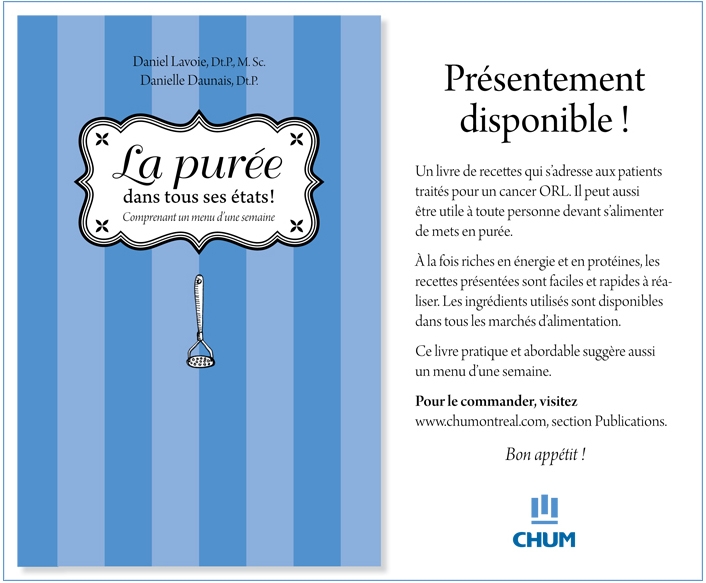
Lavoie D, Daunais D : La purée dans tous ses états! Comprenant un menu d’une semaine. Montréal: Direction des communications du CHUM, 2011.
This book is available in French only.
To order this book click on the following link:
http://www.chumontreal.qc.ca/salle-de-presse/nouvelles-du-chum/le-livre-la-puree-dans-tous-ses-etats-a-nouveau-disponible
Greer, R: Soft Options for Adults Who Have Difficulty Chewing. London: Souvenir Press Ltd., 1998.
Robertson H, Weldon D : Thick’n Tasty Cuisine. Nutrition Services, Chedoke-McMaster Hospitals, 1991.
Wilson RJ : Non-chew Cookbook, 2e éd. Colorado: Wilson Publishing Inc, 1985.
2- Video, DVD and other tools regarding clinical practice
2.1- Video – American productions:
a) «Introduction to Adult Swallowing Disorders (Pal)» (2001)
Michael A. Crary, PhD and Michael E Groher, PhD , 2nd Edition, Butterworth-Heinemann
b) «Introduction to Adult Swallowing Disorders Fluoroscopic and Endoscopic Examples» (2000)
Michael A. Crary and Michael E. Groher, Butterworth-Heinemann
c) «Managing dysphagia» (1993)
Communication Skill Builders Hutchins, D.,
Production Silence,
3830 E. Bellevue, P.O. Box 42050
Tucson, AZ. 85733
Tel.: (602) 323-7500
d) «The Three Dimensions of Puree Diet», 1990
Anderson Benner Production
Production by: Rosalind Vera Benner
Available at the paramedical library of the University of Montreal.
Tel.: (514) 343-6180
e) «Dysphagia: The latest in Instrumental Diagnostic Procedures and Service Delivery Issues» (1995)
J.Logemann, L. Zingeser (Video + 2 Audio cassettes + Information booklet)
f) «Menu for Safe Feeding» (2002)
Bridgepoint Health Foundation (English and Mandarin)
g) «Bon Appetit: How to create a Meaningful Mealtimes in Long Term Care»
Terra Nova Films, Inc. (Video 1 : 22 min. and Video 2 : 20 min.)
2.2- Video – Quebec production:
a) «Les Convives» (french)
Dietetics Department, Jacques-Viger Hospital
Tél.: (514) 842-7180, poste 216
b) «La dysphagie, de la théorie à la pratique», 1993 (french)
Dietetics Department, Sainte-Anne Veteran’s Hospital
Tel.: (514) 457-3440, ext 2155 (L. Landry)
Cost: 35 $
c) «Tout boire sans toux: malgré une dysphagie aux liquides» (french)
Information: France Fournier, Dt.P., Dietetics Department, Rivière-des-Prairies Hospital, Tel.: (514) 323-7260, ext 2304
To order: Centre de communication (CECOM), Hôpital Rivière-des-Prairies, 7070, boul. Perras, Montréal, QC H1E 1A4, Tél.: (514) 328-3503
Email: cecom.hrdp@ssss.gouv.qc.ca
d) «La dysphagie à l’Hôpital Louis-Hippolyte-Lafontaine… Une expérience à partager» (french)
Produced by Louis-Hippolyte-Lafontaine Hospital, sept. 1996
Ask for Denise Landry, Tel.: (514) 251-4000, ext 2376
2.3- DVD :
a) Sanscartier Michel: The ABCs of Videofluoroscopy of Swallowing, IUGM,
141 minutes, 2010, (514) 340-2800 ext 3262. (available in english or french)
Website: www.iugm.qc.ca
b) 3D Swallow
Description : DVD showing 3 dimensional images of oro-pharyngeal structures.
Address : PO Box 87091, Canton, MI, USA 48187-0091
Telephone : (734) 578-4940
Email : jeff@3dswallow.com
Website : www.3dswallow.com
3- Tool to evaluate the consistency of modified liquids.
Consistometer (consistometer n° 24925-000) (approximately 800 $ canadian)
C.S.C. Scientific Company Inc.
314 Lee Highway
Fairfax, VA 22031
Tel.: (703) 876-4030
Fax: (703) 280-5142
Ergonomic Aids
|
Company |
Address |
Telephone |
|---|---|---|
|
Sammons Preston Canada, An ability One Company |
755 Queensway East, |
1 (800) 665-9200 Fax: 1 (905) 566-9207 |
|
Slawner J. Ltd. |
90 Morgan |
(514) 457-6733 |
|
MEDEQUIP |
175 Stillview |
(514) 697-8868 |
|
Hanger J E Ltd. |
3881 St-Jean Blvd. |
(514) 624-0444 |
|
For a more complete list, please consult the Yellow Pages. |
||
Hmmmm....standardization!
Texture modified foods and thickened beverages
Several products are now sold by distributors or available in your local pharmacy; however it is not always possible to purchase them for home use.
We also know that standardizing recipes for texture modified foods and thickened beverages can be challenging and requires a lot of time.
If you have developed standardized recipes that you are proud of and willing to share with your colleagues to help them save time, we would appreciate if you would share your recipes with us by sending us a copy.
A blank recipe template is attached here for you to use (click here: Recipe template form.pdf), as well as an authorization form (click here: Recipe authorization form.pdf). Please send us these documents by fax at (514) 725-4433.
A signature to authorize publication will be required for each recipe submitted in order to allow us to add your recipes to our database.
Consistometer available to borrow
The Bostwick consistometer is now available to be borrowed by all APNED members. The duration of the loan is for a 3 week period.
Please consult the attached calendar for available dates for 2011 in order to plan your upcoming projects or the projects of dietetic stagiaires. Once you have selected an available date please contact us at Information@apned.info and we will confirm your request and send you the cost of borrowing which covers handling, transportation, insurance, garranty as well as a form to be signed and returned. The cheques and signed form need to be received prior to the loan. The cheque for the garranty will be returned to the borrower once the consistometer is returned in good working order, and will only be cashed if there is any damage.
We also ask that you complete a data collection table so that we can compile results from various centers in the future to share with others.
To view the calendar of availability click on the link:
Consistometer availability 2014
To view the consistometer borrowing procedures and to obtain the form to sign and return click on the following link: Procedure and request form
To view the operating instructions for the consistometer click on the following link: Operating instructions
To view the table for data collection click on the following link: Results table
Bostwick Consistometer Purchase & Abuse Protection Option
A Bostwick consistometer can be purchased online through CSC Scientific Company, Inc. The company also produces an add-on Abuse Protection Option (APO) which protects against damage to the “leveling screw platform” in the event that the consistometer is dropped. This can be installed in the company’s factory on a new unit, following a repair, or on an existing unit.
The cost of a Bostwick consistometer is approximately $499 US dollars. For information about the consistometer or to purchase click on the following links:
Information: http://www.cscscientific.com/consistometer/bostwick-consistometer/
Purchase: http://www.cscscientific.us/CSC-Bostwick-Consistometer/
The cost of the APO is approximately $75 US dollars. For information about the APO or to purchase, click on the following links:
Information: http://www.cscscientific.com/ruggedized-consistometer/?utm_campaign=Consistometer-Abuse-Protection-Option&utm_source=email/
Purchase: http://www.cscscientific.us/Consistometer/Abuse-Protection-Option-for-Consistometer/
Meal time observation report
Meal time observation form May 2005
List of potentially dangerous foods, depending on the type of dysphagia.
Examples of potentially dangerous foods 2010
FOOD ITEMS CATEGORIZED USING A CONTINUUM OF TEXTURE PARAMETERS (March 2010):
Landmark foods
Transfer note example (Revised 2010)
Transfer note 2010